My father, Dr. James P. Wesberry, arranged
with our congressmen for me to be a Page in the US House of Representatives starting March 1, 1949. I knew nothing about the
Page program and little about the House of Representatives being only 14 years of age and in the 9th grade. I was
not particularly attracted to the idea or the position but was simply told by my father that he had made the arrangements
and I would be going to Washington. I am not sure how my father learned about the Page program. I assume he read about it
or was told about it by our congressman, a good friend of his.I was the first
Page he had ever sponsored.
Page in the United States House
of
Representatives
1949
- 1951
Although my father was a prominent Baptist Minister in
Atlanta, Georgia he had always been extremely interested in politics and government. He had an extremely outgoing and winning
personality that most certainly would have led him to have gotten into politics himself had God not called him into the Gospel
ministry. He often told me and others that before that call his ambition was to become a United States Senator. While he never
engaged in partisan politics he was extremely interested in government and politics and became a close friend and counselor
in spiritual matters to almost every politician and official in the state of Georgia during the years of his ministry and
work in Atlanta (1944 – 1996). My feeling is that he wanted to pass on his great interest and unrealized ambition to
me, his only son, by enrolling me in the Page program for what he thought was going to be only three or so months until Congress
adjourned in 1949. It worked. I later was elected three times to the Georgia
State Senate, became Chairman of the largest Senate delegation (Fulton County), and was the principal plaintiff in Wesberry v. Sanders (376 US 1), the landmark Supreme Court case that in 1964 ordered the reapportionment of the
US House of Representatives where I had served as a Page.
I ended up serving three years as a Page.My initial appointment was by Congressman James C. Davis of Georgia’s 5th District in
1949. While my first month’s service was an absolutely miserable new experience to me, by the second month I came to
love the work and the experience in spite of the long hours and hard discipline. Congress did not adjourn that year until
November and by that time I was very anxious to continue but Congressman Davis had already arranged for another Page for the
1950 session.
At my urgent behest, for the 1950 year my father arranged
for another good friend of his, Congressman Brooks Hays of Arkansas to sponsor me as a Page.I was also his first Page. I continued in Page School during this time for my full 10th grade year but as
it was an election year Congress adjourned in August and I went home to Atlanta
thinking my Page service was over.
For 1951 both Congressmen Davis and Hays had already
scheduled new Pages. In addition my father was extremely anxious that his only son come back home to finish high school, so
anxious in fact that he allowed me to buy with my savings from my salary a brand new Chevrolet convertible on the condition
that I would agree to stay in Atlanta. He was somewhat repentant that he had gotten me into the Page service taking me away
from home for so long. My mother had passed away when I was seven years of age and though my father had later remarried he
and I were very, very close.
In spite of having acquired a brand new car just a few
days before my 16th birthday when I was eligible for my drivers’ license I was miserable and bored to death back in
Atlanta attending 11th grade high school during the fall of 1950. All I could think about was Washington. As the
opening of Congress approached in 1951 I begged my father to allow me to go back to visit Washington for the first two weeks’
opening of Congress and President Truman's State of the Union address. My father, who loved me very much, could never say
“no” so I drove my car to my grandmother's residence in Columbia South Carolina, left it there and took the Silver
Meteor train on to Washington. While there I was like a fish back in home waters.I covered Capitol Hill visiting all my old friends and mentors and made it well known
that I would really like to come back as a Page again. By a miracle that I have never really understood, during those two
weeks some rather extraordinary arrangements were made for me to have special joint patronage under Congressmen Davis and
Hays as a Page even though they each already had another Page in service as well. I have never known how those arrangements
came about, apparently through the actions of several older friends I had made in the Capitol who looked out for me and did
me one of the greatest favors of my entire life. I wish I could somehow thank them.
I did not know how my father would react. I knew his
heart would be broken by my leaving Atlanta again. I was sure he would take my car away from me as took the train back to
tell him I was going back to Washington. But I was greatly blessed by a father who loved me above everything else in the world.
He not only agreed for me to return to Washington but let me drive my car and gave me a Gulf Oil credit card to pay for the
gasoline. So I was able to serve my third and last year as a Page during 1951.
Some Memories
After my father had committed my going to Washington
he became concerned about me being there all alone as was the custom. He decided to do something very unusual. My father,
my stepmother and I drove to Washington during the last week of February 1949. My father had prevailed upon my very dear stepmother
who loved us both very much to actually stay in Washington with me. When we arrived he began searching for an apartment. Another
miracle happened; he found an apartment in the Methodist building right across the street from the Capitol and the Supreme
Court building. It was available for short-term rental and we immediately moved in. During the rest of the year my father
would come to Washington whenever he could for short visits. He developed a close friendship with another apartment dweller
in the same building, Dr. James Shera Montgomery, Chaplain of the House. They became such good friends that when Dr. Montgomery
took his vacation in August 1949 he asked my father to replace him. Thus something totally unplanned occurred.My father served as Acting Chaplain of the House during that month. It was one of the highlights of his
entire life as he became a friend many of the Congressmen from across the nation.
I will never forget my first day as a Page. Although
on the preceding Friday I had visited with my parents Capitol Page School then located in the basement of the Capitol, that
first morning when I left the Methodist building and crossed the Capitol grounds in the dark morning hours seeking to enter
I became confused and went around to the back side of the Capitol where I knew the Page school was located. I climbed the
steps and could actually see through the windows the Pages arriving in the classrooms but I could not find the door through
which to enter the building. It was very cold at 6:15 AM on March 1, 1949. I was wearing a suit and tie as required but had
no overcoat. I walked around and around that side of the Capitol getting colder and colder until finally it dawned on me that
the door must be on the other side of the building. I finally walked all the way around that large building and found the
entrance under the steps on the Senate side of the Capitol. There the Capitol police explained to me how to get downstairs
to Page school. So I was very frustrated and very late on my first day of school and work.
Once I got to the House Floor after school was out at
9:15 AM the very dynamic and ebullient Republican Chief Page Joe Bartlett began my induction into what turned out to be a
rather premature and frightening service in the United States Marine Corps located in a corner of the floor of the United
States House of Representatives. Joe had served in the Marines and did not realize he was now out so he ran the Republican
Page operation like a small unit of the Marines.
My father had been somewhat mortified that I was assigned
to work on the Republican side as all our family, being from the South, were lifelong Democrats. He got over it slowly after
understanding that all Page patronage was with the majority party. Actually it was a wonderful thing as I was a spoiled only
son who desperately needed the militant discipline that only Joe Bartlett was capable of delivering under the cover of the
world’s greatest democracy’s legislative chamber.
One of the first things Joe did was show me the electronic
Page summoning system of the House Floor, give me an indecipherable card with a diagram of the seating and index of call numbers
and a pictorial directory of the members of Congress. He then told me that I would be expected to learn to recognize all the
Republican Members by name both when I was facing them and when I came up behind them on the House floor at their electronic
call to run errands for them. I thought he was crazy. I knew I could never learn all those names and faces, much less the
backs of their heads. Yet within a couple months I had learned all of them. I had no choice.And within a few months more I had learned most of the Democrats as well, not because I had to, but because I had learned
to love the work and it was my job. I will never forget Joe. In fact his voice still rings in my years saying, “Sit
up straight, Jimmy,” “Hold your shoulders up, Jimmy,” “Walk faster, Jimmy,” “Be alert,
Jimmy,”…Jimmy this and Jimmy that. What an experience for a 14 year old boy. Joe was my first mentor and he still
is now 62 years later. His own story of a career serving the US government beginning as a Page inspired us all. He later bounced
back between the Capitol and the Marines finally becoming House Reading Clerk as well as a Marine General. Joe only failed
at one thing…making me a Republican…but he came very close. I remained a Democrat for many years but now I am
an Independent who votes Republican most of the time. (see more about Joe Bartlett below).
Duties and Responsibilities
In those days just about everything concerned with legislation
was printed on paper and had to be sorted out and delivered to everyone concerned on Capitol Hill.So a Page’s main duty involved delivering documents or otherwise making them available. We picked
up documents usually ordered by Congressmen's offices by telephone and delivered them either to the office or committees or
on occasion to members on the floor itself. Of course our most visible duty was answering the electronic summons of Members
seated on the floor of the House when they wanted some errand run. Often we would pick up correspondence to be signed from
a Congressman's office, bring it over to him and, once signed, take it back to his office. Occasionally we would have to take
or pick up materials from a Senator’s office to deliver to a House Member. Of course there were numerous other kinds
of errands but these were the most common. Our first duty in the morning when we arrived from Page School before the session
started was to place the previous days Congressional record in a binder under each Member’s seat. A sort of old-fashioned
hard binder was laced up with shoestring type laces that we had to tie in place. On Saturday mornings we unlaced and took
out all that week’s old Congressional records leaving the binder empty to be refilled starting the following Monday
morning. The old Congressional records were bound and stored in a dark part of the Capitol basement available to be sent if
requested to Congressmen who wanted additional copies of a particular speech or day's activity. Those were my responsibilities
during my first year in 1949 as a “Bench” Page.The term “bench”
referred to the fact that there were two benches to seat the Pages in each of the two back corners of the Chamber, one corner
for service to Democrats and the other for Republicans.In the middle at the
“V” was the Page Overseer’s desk which had the electronic summoning system built into it with small red
lights that lit when a Member pushed a button at his seat. Bench Pages were differentiated from usually more senior “Telephone
Pages” that answered the cloakroom telephones for Members. As in the House itself at that time all Page promotions were
based upon seniority.
Since most Pages served only a year or less (some only
a month) I was fortunate to be promoted to Assistant Republican Overseer in 1950 and very shortly thereafter to Overseer of
Republican Pages. This was a cushy job that involved no running of errands, just sitting at the desk and directing the work
of the Bench Pages. What really made it a soft job was that the custom had long been established that the Overseer and Assistant
Overseer alternated working every other hour so I now had every other hour off during normal working hours. Most of the time
when the House was in session I stayed on the floor and listened to debates and I came to know a great deal about the workings
of the House and the entire legislative process. At other times I would take my hourly recess as an opportunity to visit friends
in the Capitol building and talk to them. I learned a great deal in this manner.
The Overseer's duties primarily involved assigning tasks
to each of the Pages in such a way that the work was distributed on equal basis and that each had opportunities to do different
things as well gaining a broad experience. The Overseer also maintained a written
log of all the errands run and duties performed by the Pages. Of course when the House was in session the Overseer had to
keep a sharp eye on the panel of red electric lights so that anytime a light flashed on he could dispatch a page to answer
the Member’s call immediately. There was nothing more embarrassing than failing to see a light when a member called
due to being distracted by a conversation or perhaps what was happening on the Floor itself. I tried to develop a strong discipline
of keeping my eyes on the panel no matter what else I was doing. Serving as House
Republican Overseer of Pages was my first supervisory challenge and my favorite assignment as a Page. During this time Chief
Page Joe Bartlett went back on active duty in the Marines and the fellow who was named to replace him, a handicapped war veteran,
had no experience in the House, little interest in the Pages and exercised practically no supervision over us. I had to keep
things going with as much of Joe’s discipline as possible. Some Pages found it hard to accept discipline from another
Page who was their age. I ended up having the only fist fight of my entire life with one upstart down in the basement tunnels
under the Capitol. Nevertheless things worked out well and we got our job done with honor.
Capitol Page School
During my first year Page School was located in the basement
of the Capitol building itself. It was soon moved to the fourth floor of the Library of Congress across the street from the
Capitol. The curriculum was pretty much the same as high school in Atlanta except for the fact that it did not include, due
to time limitations, non-essential activities such as physical education, shop, study hall, music and art. That suited me
just fine because what I really liked at school was the serious study part. I made good grades even though the schedule of
school early in the morning followed by a full day's work was rather unusual. The school was part of the District of Columbia
public school system and had excellent teachers in my opinion. I believe I received as good or better education than I would
have in the Atlanta public school system. I was active in the few extracurricular activities that existed, became a member
of the National Honor Society and the Student Council. During my last semester I was elected President of the Student Council.
I would have to say however that I learned a lot more on the floor of the House and in talking with friends in the Capitol
than I did in school.
I did not have the privilege of graduating from Capitol
Page school due to another rather miraculous occurrence. One of the Pages from South Carolina had taken the entrance exams
at Harvard while in the 11th grade and gained admission directly without doing the 12th grade. When I heard about this I thought
it was a great idea but I wanted to go to a Southern University so I applied to take the entrance exams at Duke University,
drove down to Durham, North Carolina, took the exams and was also admitted immediately without having to take the 12th grade.
I was also given a small financial scholarship to help with costs apparently based on the high grades I made on the exams.
I did participate in the Page School graduation ceremony
in June 1951 as well as the senior prom since I was the Student Council President. At the graduation ceremony I served as
Marshall and led the procession of the graduates down the aisle at the beginning and back at the end, but I never got a CPS
diploma. However that summer I attended a nighttime summer school at Emerson Institute which mainly provided classes for returning
servicemen under the G.I. Bill of Rights and obtained enough credits to get a high school diploma from Emerson Institute.
This was made possible because several of us had also obtained some extra credits by taking a streetcar to attend night school
classes after work during the regular school year.During this time our hours
were from 6:15 AM until 10:00 PM but it was worth it. This prepared me for later on when I worked my way through college while
raising a family observing similar hours.
A Typical Day
As indicated the Page’s day started when the alarm
clock went off about 5:15 in the morning making it possible to get to school by 6:15 AM if one lived on Capitol Hill. In early
1951 I lived for a while in northern Virginia and had to start out much earlier. School lasted three hours or so and was out
around 9:15 AM so work began at 9:30 on the House floor and involved putting out the Congressional Records, running errands
and doing all sorts of things with occasional short periods of time off for the Bench Pages. Of course once I became Overseer,
as mentioned, I had every hour off providing the opportunity to learn all I could about what was going on and to spend some
time talking to friends. We usually had both snacks and lunch in the cloakroom where a snack bar was maintained for members
by Helen, a black lady whose father before her had run the snack bar. She had an outgoing personality and provided us with
excellent food of the type young boys (and Congressmen) appreciated. It would be called “fast food” today. Helen
became a good friend to all of us. She was probably the first black person I ever knew as a friend as I had come up in the
segregated South where I had almost no contact at all with black people. Even in Washington at Page School and among the Pages,
all were white males in those days.
My second black friend, to whom I became even closer,
was George Robinson who worked in the House Document Room in a sort of an attic annex on the fourth floor of the Capitol building
all by himself. We would often have to obtain certain documents from that part of the Document Room so during my first year
I got to know George and we became good friends even though there was probably a difference of 40 years in our ages. George
was a Republican from Colorado. We talked politics a great deal and he taught me a lot. During the second and third years
when I had every other hour off I would often find my way up to the attic where George worked to spend time talking to him
because I enjoyed it and learned a lot from him. I guess he was my second mentor. Those two friendships lasted for many years
after I left a service. For many years thereafter whenever I traveled to Washington I would always stop by the Capitol to
say hello to both Helen and George. Helen ran the snack bar for many more years and George moved over to the balcony of the
House chamber as a doorkeeper. Finally it became very difficult to see these friends as Capitol security became so strict
that I could not get in the building during visits to Washington.
Other Memories
Back in the days when I was a Page Washington was a pretty
tranquil place. Crime was not in the news and Pages were unsupervised and free to live wherever they wanted. While during
my first year I lived with my stepmother at the Methodist Building, my second and third years were more typical of the Page’s
life. I lived for short periods in quite a number of different places. The first one was a boarding house which a lady maintained
primarily for pages on New Jersey Avenue just beyond the House Office Buildings. Later on I moved around to different places
living for a time in the basement of the Dodge Hotel where neighbors included the members of the Washington Senators baseball
team among others. Then I lived in another boarding house located across from the Senate office Building just behind the Methodist
Building rooming with another Page. After I brought my car to Washington I lived in a Virginia with a family who were friends
of my parents for a while but the commute was very tough due to the early morning school hours so I finally ended up renting
an apartment with two other Pages on B Street just across from what was then called the Old House Office Building and the
Library of Congress. In those days even though there was no supervision at all over Pages very few pages had problems or got
into trouble. I only remember one or two who had discipline imposed on them but then it was either from their congressman
or from their parents. We grew up very fast as Pages because we were on our own and most of us got married very young as I
did.
The Cloakroom staff consisted mainly of the older Telephone
Pages and Helen, already described. We were all friends and worked closely together. The Doorkeeper of the House was “Fishbait”
Miller who became a very close friend of my father over the following years but
I personally had little to do with him.Ralph R, Roberts was Clerk of the House.I hardly knew him but his nephew, John Roberts was a Page and a close friend.
House Members in 1949 who would go on to greater fame
were Richard Nixon, John Kennedy, Gerald Ford, and quite a few others who moved on to the Senate.Congressman Gavin of Pennsylvania took a particular interest in me and encouraged me.He also became a friend of my father.
During my time there were no special events organized
for the Pages other than events at Page School. We did attend the annual Congressional baseball game and the annual air show
at Andrews Air Base. I was really so busy between school and work that I had no time for other events or activities. One summer
we enjoyed weekend canoeing on the Potomac until we were overturned by a passing motor boat and had to return via streetcar
wringing wet.
During the time of my service the House Chamber was completely
remodeled and for several monthsHouse sessions were held in the Ways & Means
Committee Room in what was then called the New House Office Building. This room was far too small and the sessions were often
crowded. We Pages had to sit at the front of the Chamber (like the Senate Pages still do but in chairs) and watch for Members
to snap their fingers or motion for us to attend them. Indian Prime Minister Nehru spoke to a joint session during that time
and I was in a picture of his speech along with two other Pages that appeared nationwide in the My Weekly Reader publication distributed to schools across the nation. I wish I had retained a copy of it.
When we returned to the House Chamber I was the first
House Republican Page Overseer to use the new, shiny and technologically updated Page call desk a great improvement for us.
It replaced the old wooden desk that had become very ugly over the years due to Pages carving their names, initials and messages
in it. To this day the Chamber has continued to appear the same as when it was then redecorated.When I see it on television now a great lump forms in my throat and I become very sentimental. Over the
years following my service I would return and take friends on tours of the Capitol and if they were special personalities
I would ask Joe Bartlett, then House Republican Reading Clerk, to invite them onto the House floor while not in session. Everyone
loved to sit in the Speaker’s chair. Once security became very strict this was no longer possible.
Two Memorable Addresses
I became extremely interested in the legislative process
and the matters before the House and never missed an important speech or debate but there were two absolutely unforgettable
addresses that constitute my most unforgettable experiences.The first was Richard
Nixon’s address under a Special Order late in the afternoon on January 26, 1950 exposing the Alger Hiss “Pumpkin
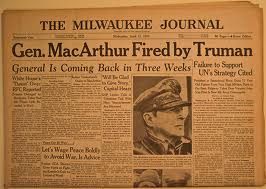
Papers” revealed by Whittaker Chambers. The second and even more important address was General Douglas MacArthur’s
“Old Soldiers Never Die” farewell address on April 19, 1951 upon his return after being relieved of command by
President Truman. I hope one day to write in more detail about these two events.
We Pages hated Special Orders because they usually caused
us to have to work overtime. Members reserved time in advance usually 5 to 15 minutes for speeches at the end of the day’s
session when all business was complete and most Members had left the floor. Their reservations were printed in advance in
the Daily Digest so we would always know ahead of time how many short speeches were planned at the end of each day’s
session. Usually they would all be very short with an occasional speech reserved for 30 minutes to our dismay. We were startled
when Richard Nixon reserved a few weeks early a full hour for an afternoon Special Order. As the date approached a new Daily
Digest came out indicating he had increased the request to two hours, something absolutely unheard of. Needless to say we
were mortified that we would have to sit through a two hour speech to an empty chamber and probably wouldn't get home until
evening. The big day came and we received another big shock. Normally during special order sessions that would only be two
of three members on the floor, usually one from each party and the person speaking. The purpose of the Special Order was really
just to get the speech in the Congressional Record.
On this day as the hour approached…I believe it
was about 5:00 PM…instead of the chamber emptying out, it got more and more crowded until finally almost every member
of Congress was on the floor as Richard Nixon began his speech and it dawned on us that we were going to see something historic.
Incredibly the speech lasted more than two hours, almost three, and no one left the chamber.I remember standing at the back rail listening standing beside the then House Republican Overseer, also a political
junkie like me and a good friend, Bob Curtis who was a dedicated Republican. Bob turned to me near the end of the speech and
said, “You know what, Jim, Richard Nixon will be elected President of the United States in 1984.” Bob was right
about the election of Nixon but his time estimate was a bit late.
When Nixon finished speaking he received a standing ovation
from every single Member of the House on both sides of the aisle. Many observers said they had never seen anything like it
in the House Chamber.
The most excitement I ever saw in Washington while a
Page was when President Truman fired General MacArthur. The Republicans were apoplectic. Former Speaker Joe Martin was so
flushed that we expected him to have a heart attack any minute. There was talk of impeaching Truman. Democrats were in panic
and many of them did not support the decision but did not speak publicly about it.So
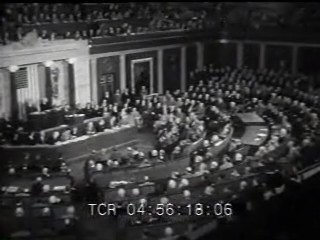
General MacArthur came home to speak to the historic joint session with more security in the Capitol Building than I had ever
seen. There was also more press coverage than I had ever seen. That was it only time I ever pulled rank as Overseer. I had
my assistant man the Page desk and I went down the front of the chamber to be as close as possible to General MacArthur. You
can see me in the pictures of the event under the portrait of Gen. Lafayette.
As the dignitaries entered the chamber there were the
great heroes of World War II that I had read and seen so much about in the news reels of the war.The most compelling character was General Wainwright thin and frail, never able to recover his full health
after the Bataan Death March.
Speaking to a packed chamber, MacArthur was probably
the greatest orator I ever heard in my life. He maintained the rapt attention of every member of Congress throughout the speech.
I learned later from Pages on the Democratic side that at some point Congresswoman Bosone of Maryland had rushed from the
chamber in tears. But what stunned me as a 16-year-old boy who had been taught from childhood that grown men don’t cry…what
went on right in front of me not more than 1 yard away…became a lifelong memory. Now a California Senator, Richard Nixon,
was seated on the end of the row directly in front of me. On his other side was the other California Senator William Knowland.
As the speech became more and more a tragic goodbye message
from one of the greatest military heroes the world has ever known I looked at Nixon through my own tear filled eyes and saw
to my amazement tears streaming down his face ashamedly with no effort to wipe them away. Senator Knowland was wiping his
eyes with a handkerchief and probably almost everybody in the chamber was doing the same, but my eyes were riveted on the
man I looked up to and admired and on one occasion had been able to speak with as we walked over to the House Office Building
together, the man who had made the historic Pumpkin Papers speech, overcome completely by emotion to such an extent that I
even today am moved with emotion as I try to describe it. I was crying too, but I was only a 16-year-old boy and he was a
grown man and a United States Senator. Ever since that moment I have always had a feeling of injustice about many of the evil
things that have been said about Nixon. Some of them may be true but I had the unusual privilege of seeing him in a moment
in his life when he was very honestly displaying a kind of patriotism to the United States of America like I have never ever
seen anywhere else.
Nixon’s tears impressed me even more than MacArthur’s
speech. In later years in Atlanta I worked in support of his presidential campaign even though I was a Democrat. This caused
me problems when I ran for Alderman and lost, then for the Georgia Senate and won, but I have never regretted it and would
do it again. Nixon was not the man many have painted him as being.
The Impact of Page Service on My Life
Life is a never ending educational experience and as
I reflect now, some 60 years later, I would observe two things. The earlier that education and learning enter person's life
the more impact it is likely to have.Secondly, I believe I learned more during
my three years under the dome of the United States Capitol than I did at any other time in my life including college, graduate
school and a whole life full of very unusual opportunities to gain knowledge.
My Baptist preacher father imbued me with a duty to serve
my country, something he longed to do but which in his case was superseded by his duty to serve God. By arranging for me to
become a Page he assured me of an experience that would change my life forever. Since that time I have never been interested
in anything else except government and politics and to this day, even as I live in retirement far to the south in Quito Ecuador,
I follow the public affairs of the United States and all its political campaigns in great detail and with much interest greatly
aided by cable TV and the Internet. I also follow politics in all the Latin American countries as I have worked in them all.
My great dream, of course, was to return to the Capitol
as a Congressman. But I learned many years ago as a young State Senator that even though I could not hope to achieve higher
elective public office as I and my father had both dreamed, I could serve in numerous and unusual ways and that is what I
have tried to do ever since.
In college, after dabbling in other fields of study,
including political science, I found I had a talent for accounting and became a Certified Public Accountant expecting to work
exclusively in business affairs, but my interest in government led me to specialize in governmental accounting, auditing and
financial management as well as fighting corruption at a time when few CPA’s had such an interest. This in turn led
me to gain some reputation first in Georgia and later internationally in these areas. I am sure that my professional career
would not have taken such an unusual turn had I not served as a Page.
Reapportionment of the US House of Representatives
While I never realized my dream of going back to Washington
as a Congressman, I did have the chance to do what I believe was a service to the House of Representatives where I grew from
a boy into a man. Once the US Supreme Court decided to enter the “thicket” of state legislative reapportionment
in the Baker v. Carr decision it became clear to me that the Court could no longer
sidestep the even greater question of fair Congressional district apportionment. I became the principal plaintiff in the case
that eventually was decided as Wesberry v. Sanders (376 US 1) in which the Court
ordered that all US Congressional districts be reapportioned fairly after each decennial census as originally conceived and
agreed to by the founders of the country. That decision restored the long ignored terms of the Great Compromise reached in
the Constitutional Convention of 1789 that made it possible to form the United States of America. Had I never been a Page
in the House, I could never have conceived of this historic litigation.
I am in the video below made in 1949 at 2:49 and 15:08. The blond Page with clear plastic glasses frames.
"History fails to record a single precedent in which nations subject to moral decay have not passed into political and
economical decline. There has been either a spiritual awakening to overcome the moral lapse, or a progressive deterioration
leading to ultimate national disaster." - General Douglas MacArthur, 1945
"La historia no recuenta un solo precedente en el que aquellas naciones sujetas a la decadencia moral no han pasado
a la decadencia política y económica.Ha habido o un despertar espiritual para superar lapso moral, o un deterioro progresivo
que conduce a un desastre nacional final." - General Douglas MacArthur, 1945
GeneralDouglasMacArthur
Farewell Address to Congress delivered 19 April 1951 Mr. President, Mr. Speaker and Distinguished Members
of the Congress: I stand on this rostrum with a sense
of deep humility andgreatpride
-- humility in the wake of those greatAmericanarchitects
of our history who have stood here before me; pride in the reflection that this forum of legislative debate represents human
liberty in the purest form yet devised. Here are centered the hopes and aspirations and faith of the entire human race. I
do not stand here as advocate for any partisan cause, for the issues are fundamental and reach quite beyond the realm of partisan
consideration. They must be resolved on the highest plane of national interest if our course is to prove sound and our future
protected. I trust, therefore, that you will do me the justice of receiving that which I have to say as solely expressing
the considered viewpoint of a fellow American. I address you
with neither rancor nor bitterness in the fading twilight of life, with but one purpose in mind: to serve my country. The
issues are global and so interlocked that to consider the problems of one sector, oblivious to those of another, isbutto court disaster for the whole. While Asia is commonly referred to as the Gateway
to Europe, it is no less true that Europe is the Gateway to Asia, and the broad influence of the one cannot fail to have its
impact upon the other. There are those who claim our strength is inadequate to protect on both fronts, that we cannot divide
our effort. I can think of no greater expression of defeatism. If a potential enemy can divide his strength on two fronts,
it is for us to counter his effort. The Communist threat is a global one. Its successful advance in one sector threatens the
destruction of every other sector. You can not appease or otherwise surrender to communism in Asia without simultaneously
undermining our efforts to halt its advance in Europe.Beyond
pointing out these general truisms, I shall confine my discussion to the general areas of Asia. Before one may objectively
assess the situation now existing there, he must comprehend something of Asia's past and the revolutionary changes which have
marked her course up to the present. Long exploited by the so-called colonial powers, with little opportunity to achieve any
degree of social justice, individual dignity, or a higher standard of life such as guided our own noble administration in
the Philippines, the peoples of Asia found their opportunity in the war just past to throw off the shackles of colonialism
and now see the dawn of new opportunity, a heretofore unfelt dignity, and the self-respect of political freedom.Mustering half of the earth's population, and 60 percent of its natural resources
these peoples are rapidly consolidating a new force, both moral and material, with which to raise the living standard and
erect adaptations of the design of modern progress to their own distinct cultural environments. Whether one adheres to the
concept of colonization or not, this is the direction of Asian progress and it may not be stopped. It is a corollary to the
shift of the world economic frontiers as the whole epicenter of world affairs rotates back toward the area whence it started.In this situation, it becomes vital that our own country orient its policies in
consonance with this basic evolutionary condition rather than pursue a course blind to the reality that the colonial era is
now past and the Asian peoples covet the right to shape their own free destiny. What they seek now is friendly guidance, understanding,
and support -- not imperious direction -- the dignity of equality and not the shame of subjugation. Their pre-war standard
of life, pitifully low, is infinitely lower now in the devastation left in war's wake. World ideologies play little part in
Asian thinking and are little understood. What the peoples strive for is the opportunity for a little more food in their stomachs,
a little better clothing on their backs, a little firmer roof over their heads, and the realization of the normal nationalist
urge for political freedom. These political-social conditions have but an indirect bearing upon our own national security,
but do form a backdrop to contemporary planning which must be thoughtfully considered if we are to avoid the pitfalls of unrealism.
Of more direct and immediate bearing upon our national security
are the changes wrought in the strategic potential of the Pacific Ocean in the course of the past war. Prior thereto the western
strategic frontier of the United States lay on the littoral line of the Americas, with an exposed island salient extending
out through Hawaii, Midway, and Guam to the Philippines. That salient proved not an outpost of strength but an avenue of weakness
along which the enemy could and did attack. The Pacific was
a potential area of advance for any predatory force intent upon striking at the bordering land areas. All this was changed
by our Pacific victory. Our strategic frontier then shifted to embrace the entire Pacific Ocean, which became a vast moat
to protect us as long as weheldit.
Indeed, it acts as a protective shield for all of the Americas and all free lands of the Pacific Ocean area. We control it
to the shores of Asia by a chain of islands extending in an arc from the Aleutians to the Mariannas held by us and our free
allies. From this island chain we can dominate with sea and air power every Asiatic port from Vladivostok to Singapore --
with sea and air power every port, as I said, from Vladivostok to Singapore -- and prevent any hostile movement into the Pacific.
*Any predatory attack from
Asia must be an amphibious effort.*No amphibious
force can be successful without control of the sea lanes and the air over those lanes in its avenue of advance. With naval
and air supremacy and modest ground elements to defend bases, any major attack from continental Asia toward us or our friends
in the Pacific would be doomed to failure. Under such conditions,
the Pacific no longer represents menacing avenues of approach for a prospective invader. It assumes, instead, the friendly
aspect of a peaceful lake. Our line of defense is a natural one and can be maintained with a minimum of military effort and
expense. It envisions no attack against anyone, nor does it provide the bastions essential for offensive operations, but properly
maintained, would be an invincible defense against aggression. The holding of thislittoraldefense line in the western Pacific is entirely dependent upon holding all
segments thereof; for any major breach of that line by an unfriendly power would render vulnerable to determined attack every
other major segment. This is a military estimate as to which
I have yet to find a military leader who will take exception. For that reason, I have strongly recommended in the past, as
a matter of military urgency, that under no circumstances must Formosa fall under Communist control. Such an eventuality would
at once threaten the freedom of the Philippines and the loss of Japan and might well force our western frontier back to the
coast of California, Oregon and Washington. To understand the
changes which now appear upon the Chinese mainland, one must understand the changes in Chinese character and culture over
the past 50 years. China, up to 50 years ago, was completely non-homogenous, being compartmented into groups divided against
each other. The war-making tendency was almost non-existent, as they still followed the tenets of the Confucian ideal of pacifist
culture. At the turn of the century, under the regime of Chang Tso Lin, efforts toward greater homogeneity produced the start
of a nationalist urge. This was further and more successfully developed under the leadership of Chiang Kai-Shek, but has been
brought to its greatest fruition under the present regime to the point that it has now taken on the character of a united
nationalism of increasingly dominant, aggressive tendencies. Through
these past 50 years the Chinese people have thus become militarized in their concepts and in their ideals. They now constitute
excellent soldiers, with competent staffs and commanders. This has produced a new and dominant power in Asia, which, for its
own purposes, is allied with Soviet Russia but which in its own concepts and methods has become aggressively imperialistic,
with a lust for expansion and increased power normal to this type of imperialism. There is little of the ideological concept either one way or another in the Chinese make-up. The standard
of living is so low and the capital accumulation has been so thoroughly dissipated by war that the masses are desperate and
eager to follow any leadership which seems to promise the alleviation of local stringencies. I have from the beginning believed that the Chinese Communists' support of the North Koreans was the
dominant one. Their interests are, at present, parallel with those of the Soviet. But I believe that the aggressiveness recently
displayed not only in Korea but also in Indo-China and Tibet and pointing potentially toward the South reflects predominantly
the same lust for the expansion of power which has animated every would-be conqueror since the beginning of time. The Japanese people, since the war, have undergone the greatest reformation recorded
in modern history. With a commendable will, eagerness to learn, and marked capacity to understand, they have, from the ashes
left in war's wake, erected in Japan an edifice dedicated to the supremacy of individual liberty and personal dignity; and
in the ensuing process there has been created a truly representative government committed to the advance of political
morality, freedom of economic enterprise, and social justice. Politically,
economically, and socially Japan is now abreast of many free nations of the earth and will not again fail the universal trust.
That it may be counted upon to wield a profoundly beneficial influence over the course of events in Asia is attested by the
magnificent manner in which the Japanese people have met the recent challenge of war, unrest, and confusion surrounding them
from the outside and checked communism within their own frontiers without the slightest slackening in their forward progress.
I sent all four of our occupation divisions to the Korean battlefront without the slightest qualms as to the effect of the
resulting power vacuum upon Japan. The results fully justified my faith. I know of no nation more serene, orderly, and industrious,
nor in which higher hopes can be entertained for future constructive service in the advance of the human race. Of our former ward, the Philippines, we can look forward in confidence that the
existing unrest will be corrected and a strong and healthy nation will grow in the longer aftermath of war's terrible destructiveness.
We must be patient and understanding and never fail them -- as in our hour of need, they did not fail us. A Christian nation,
the Philippines stand as a mighty bulwark of Christianity in the Far East, and its capacity for high moral leadership
in Asia is unlimited. On Formosa, the government of the Republic
of China has had the opportunity to refute by action much of the malicious gossip which so undermined the strength of its
leadership on the Chinese mainland. The Formosan people are receiving a just and enlightened administration with majority
representationonthe
organs of government, and politically, economically, and socially they appear to be advancing along sound and constructive
lines. With this brief insight into the surrounding areas,I now turn to the Korean conflict. While I was not consulted prior to the President's
decision to intervene in support of the Republic of Korea, that decision from a military standpoint, proved a sound one, as
we -- as I said, proved a sound one, as we hurled back the invader and decimated his forces. Our victory was complete, and
our objectives within reach, when Red China intervened with numerically superior ground forces. This created a new war and an entirely new situation, a situation not contemplated when our forces were
committed against the North Korean invaders; a situation which called for new decisions in the diplomatic sphere to permit
the realistic adjustment of military strategy. Such
decisions have not been forthcoming. While no
man in his right mind would advocate sending our ground forces into continental China, and such was never given a thought,
the new situation did urgently demand a drastic revision of strategic planning if our political aim was to defeat this new
enemy as we had defeated the old. Apart
from the military need, as I saw It, to neutralizethesanctuary
protection given the enemy north of the Yalu, I felt that military necessity in the conduct of the war made necessary:firstthe intensification
of our economic blockade against China;twothe
imposition of a naval blockade against the China coast;threeremoval of restrictions on air reconnaissance of China's coastal areasand of Manchuria;fourremoval
of restrictions on the forces of the Republic of China on Formosa, with logistical support tocontributeto their effective operations against the common enemy. For entertaining these views, all professionally designed to support our forcescommitted
toKorea and bring hostilities to an end with the least possible delay
and at a saving of countless Americanandallied
lives, I have been severely criticized in lay circles, principally abroad, despite my understanding that from
a military standpoint the above views have been fully shared in the past by practically every military leader concerned with
the Korean campaign, including our own Joint Chiefs of Staff. I
called for reinforcements but was informed that reinforcements were not available. I made clear that if not permitted to destroy
the enemy built-up bases north of the Yalu, if not permitted to utilize the friendly Chinese Force of some 600,000 men on
Formosa, if not permitted to blockade the China coast to prevent the Chinese Reds from getting succor from without, and if
there were to be no hope of major reinforcements, the position of the command from the military standpoint forbade victory.
We could hold in Korea by constant maneuver and in an approximate
area where our supply line advantages were in balance with the supply line disadvantages of the enemy, but we could hope at
best for only an indecisive campaign with its terrible and constant attrition upon our forces if the enemy utilized its full
military potential. I have constantly called for the new political decisions essential to a solution. Efforts have been made to distort my position. It has been said, in effect, that
I was a warmonger.Nothingcould
be further from the truth. I know war as few other men now living know it, and nothing to me is more revolting.
I have long advocated its complete abolition, as its very destructiveness on both friend and foe has rendered it useless as
a means of settling international disputes. Indeed,onthe
second day of September, nineteenhundred andforty-five,
just following the surrender of the Japanese nation on the Battleship Missouri, I formally cautioned as follows: Men since the beginning of time have sought peace. Various methods
through the ages have been attempted to devise an international process to prevent or settle disputes between nations. From
the very start workable methods were found in so far as individual citizens were concerned, but the mechanics of an instrumentality
of larger international scope have never been successful. Military alliances, balances of power, Leagues of Nations, all in
turn failed, leaving the only path to be by way of the crucible of war. The utter destructiveness of war now blocks
out this alternative. We have had our last chance. If we will not devise some greater and more equitable system, Armageddon
will be at our door. The problem basically is theological and involves a spiritual recrudescence and improvement of human
character that will synchronize with our almost matchless advances in science, art, literature, and all material and cultural
developments of the past 2000 years. It must be of the spirit if we are to save the flesh. But once war is forced upon us,
there is no other alternative than to apply every available means to bring it to a swift end. War's very object is victory, not prolonged indecision. In war thereisno
substitute for victory. There are some who, for
varying reasons, would appease Red China. They are blind to history's clear lesson, for history teaches with unmistakable
emphasis that appeasement but begets new and bloodier war. It points to no single instance where this end has justified that
means, where appeasement has led to more than a sham peace. Like blackmail, it lays the basis for new and successively
greater demands until, as in blackmail, violence becomes the only other alternative. "Why," my soldiers asked of me, "surrender military advantages to an enemy in the field?" I could not
answer. Some may say: to avoid spread of the conflict into an
all-out war with China; others, to avoid Soviet intervention. Neither explanation seems valid, for China is already engaging
with the maximum power it can commit, and the Soviet will not necessarily mesh its actions with our moves. Like a cobra, any
new enemy will more likely strike whenever it feels that the relativity in military or other potential is in its favor on
a world-wide basis. The tragedy of Korea is further heightened
by the fact that its military action is confined to its territorial limits. It condemns that nation, which it is our purpose
to save, to suffer the devastating impact of full naval and air bombardment while the enemy's sanctuaries are fully protected
from such attack and devastation. Of the nations of the world,
Korea alone, up to now, is the sole one which has risked its all against communism. The magnificence of the courage and fortitude
of the Korean people defies description. They have chosen to
risk death rather than slavery. Their last words to me were: "Don't scuttle the Pacific!" I have just left your fighting sons in Korea. They havemet
all tests there, and I can report to you without reservation that they are splendid in every way. It was my constant effort to preserve them and end this savage conflict honorably
and with the least loss of time and a minimum sacrifice of life. Its growing bloodshed has caused me the deepest anguish and
anxiety. Those gallant men will remain often in my thoughts
and in my prayers always. I am closing my 52 years of
military service. When I joined the Army, even before the turn of the century, it was the fulfillment of all of my boyish
hopes and dreams. The world has turned over many times since I took the oathon
theplainat
West Point, and the hopes and dreams havelongsince vanished, but
I still remember the refrain of one of the most popular barrack ballads of that day which proclaimed most proudly that "old
soldiers never die; they just fade away." And like
the old soldier of that ballad, I now close my military career and just fade away, an old soldier who tried to do his duty
as God gave him the light to see that duty. Good Bye.
General Douglas MacArthur addresses Joint Session of Congress, April 19, 1951
Video of the first part of General MacArthur's historic
speech...
was Chief Page during most of the time I served
as a House Page
BIOGRAPHY
Dorsey Joseph Bartlett was born on August 7, 1926, in Clarksburg, West Virginia.
He was the sixth of ten children of Blanche Hacker Bartlett and Flavius Dorsey, an efficiency engineer in the glass business.
Bartlett lived on the family farm in central West Virginia and attended local schools. After being named “America’s
Typical Schoolboy Patrolman,” he was awarded a 30-day appointment as a House Page on August 1, 1941, with the help of
Representative Wright Patman of Texas. Later, having impressed Doorkeeper Joe Sinnott and House Clerk South Trimble, Bartlett
received irregular Page appointments while serving as Page Overseer and attending the Capitol Page School. Upon graduating
in 1944, Bartlett enlisted in the U.S. Marine Corps. He was honorably discharged as a Private First Class in September 1945.
Returning to the Capitol after his service in World War II, Bartlett was appointed
the Republican chief of Pages by Speaker Joe Martin of Massachusetts. He oversaw the work of several dozen House Pages, some
as young as 11 years old. Commissioned from the ranks of the Marine Corps Reserve, Bartlett was recalled to active duty in
January 1951 and served until June of 1952. From 1953 to 1971, Bartlett was a House reading clerk, sharing duties on the rostrum
and working with the Speaker’s and the Clerk’s offices on numerous floor-related and administrative tasks. Bartlett
also served as chief reading clerk for six Republican National Conventions. From May 1971 until he retired, Bartlett served
as Minority Clerk.
In January 1979, a year after retiring from the Marine Corps as a Brigadier General,
Bartlett retired from the House. During his career, Bartlett received honorary law degrees from the Atlanta Law School and
Salem College. He was also awarded the Legion of Merit, and in 1982 he was the Distinguished Scholar in Residence at the Federal
Executive Institute. Bartlett and his wife, the former Virginia Bender, have two grown daughters: Linda and Laura.
They were held down in what is I think now is the air conditioning
room. It’s called the West Terrace, right close to where President Reagan established the way of getting sworn in. It’s
in that part of the Capitol, on the west side. It was dank. We generated our own electricity. We, the Capitol, generated its
own electricity in those days. It was direct current. So if you brought an alternating current device in, you’d probably
lost it, like that. {laughter} But it was done right across the hall from Page School. And those whine of those generators
was constant. They were big! And we met down there. It was a private school. It was conducted by E. L. Kendall. He was the
principal, a very Spartan Baptist gentleman. I happened to like him very much. But he was straight-laced. There was no doubt
about that. We paid $19 a month for tuition. And there were other maintenance problems down there. The roof leaked. And it
was not completely uncommon to go in there and find that on the floor there was a puddle. And you had to put down planks so
we could arrive at our seats. We’d walk in on the planks, take our seats, hold our feet up, and study Latin. It was
something to have happen. And incidentally, one time a fellow switched on the light, and the light bulb—the light globe
was full of water, and of course it went kapoop then. {laughter} We had a darkened room. There was another problem down in
that area. This was a forsaken area at that time. Nobody went down there.
House Page Responsibilities
In those days we worked a half a day Saturday every Saturday, and worked hard.
Because that was the day we took thoseCongressional Recordsout
from the seats and did what we called stripping theRecords. And we took them down to a dungeon down
below what was the then the Doorkeeper’s office. We had a…I don’t know what it is now because they’ve
decided to use much of that space for other purposes. But it was a dungeon full of steel locker boxes. And we put them in
there in order by date so that we could…As Members would call up regularly. “I need a copy—I need ten copies,”
of a particular date. “Be right over.” And they were always amazed that we had those resources. Well, the reason
we had them was because the Pages spent Saturday taking them from the floor and putting them on file downstairs. And it was
true. We were able to make a pretty good account of ourselves in retrieving those and supplying the needs of the Members.
Then we did what was called skeletonizing. I made quite a reputation of this. But when on Saturdays, when we didn’t
have any other thing to do, we would take aRecordand
strip out those things where 10 Members would have something significant in aRecord. So I would skeletonize
aRecord, provide 10 Members with that portion of theRecord. See, this was before Xerox. This was before
duplication, printing. And so to be able to give a Member 50 copies of a choice item, he was very appreciative. This is why
they knew my name.
Most people, I think, know, that there’s a Page calling
system on the floor. It was all electronically. It’s been upgraded. They have a much better system there, now. But it
has a diagram of the floor. And when a bell or a sign would light up, you could tell the Page taking his little card that
has the diagram, he could go directly to that seat, without any trouble. And that’s your number one priority. At least
it was when I was Chief Page. Your number one priority is to respond to the calls on the floor. And that would involve a lot
of things. But that—the direct service to the Members of Congress, that was put above everything else. Concurrent with
that, we would get phone calls coming into the cloakroom, wanting documents from the old document room, and things of that
nature. That was the second priority. And we would dispatch them from that location. In our instance, it was the Northwest
corner of the House Floor. We had two benches without cushions. And we would try to maintain a few boys on those benches.
We’d sometimes have eight or 10 sitting there, waiting for their next assignment. But most of the time, we were lucky
to have two or three there, waiting to take care of the House Floor, if it was a busy time of day, a busy legislative situation.
Whenever you find you
are on the side of the majority, it is time to pause and reflect
--- Mark Twain
We have never observed
a great civilization with a population as old as the United States will have in the twenty-first century; we have never observed
a great civilization that is as secular as we are apparently going to become; and we have had only half a century of experience
with advanced welfare states...Charles Murray
Kella
This is a personal website containing personal information and some news and personal opinions on
certain issues affecting democratic governance of interest to me and my friends, associates and seminar participants. The
financial information, charts, etc., consist of items I find interesting. Draw your own conclusions from it.
Copyright Notice: In accordance with Title 17 U. S. C. Section 107,
any copyrighted work on this website is distributed under fair use without profit or payment to those who have expressed an
interest in receiving the included information for nonprofit research and educational purposes only. Ref.: http://www4.law.cornell.edu/uscode/17/107.html